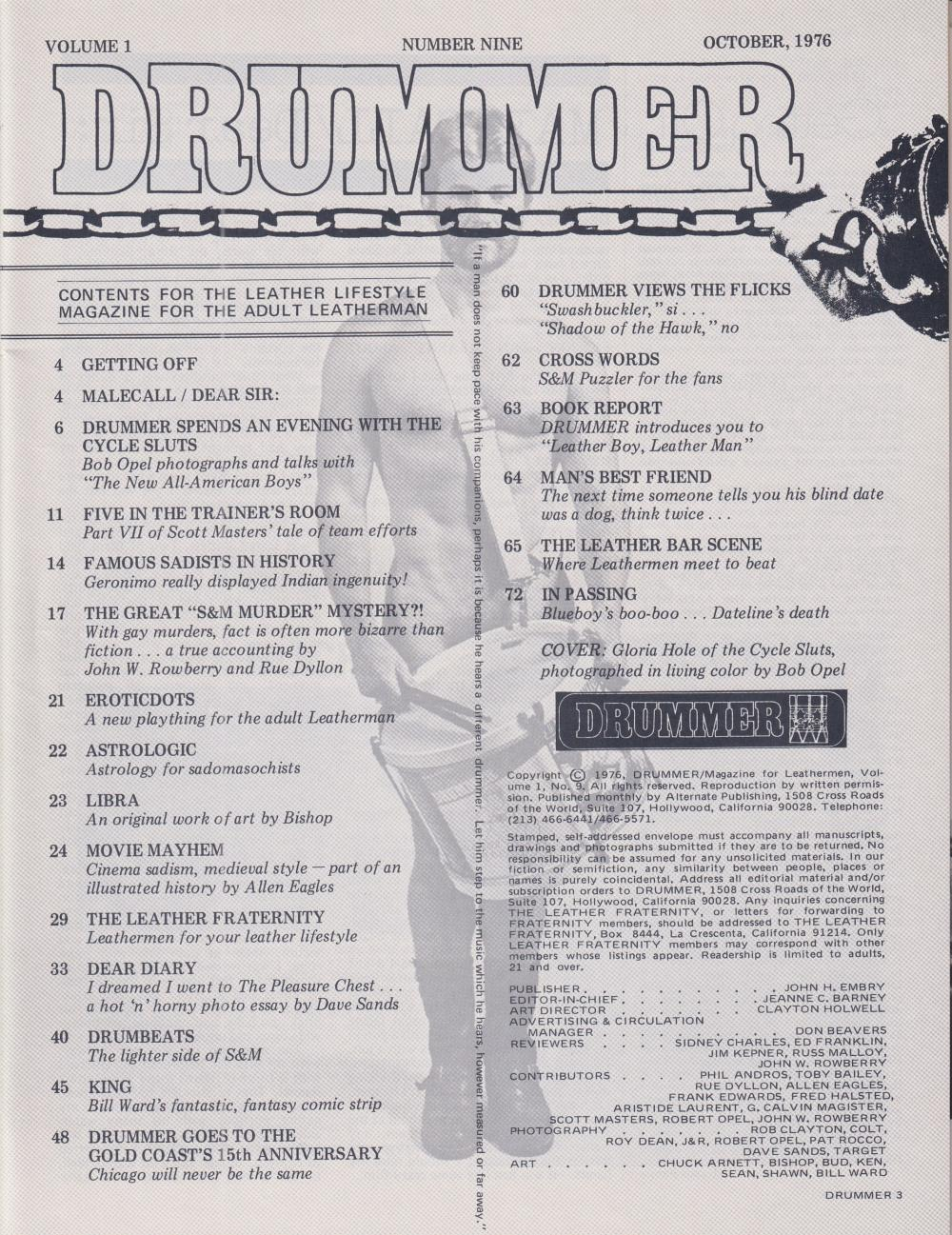
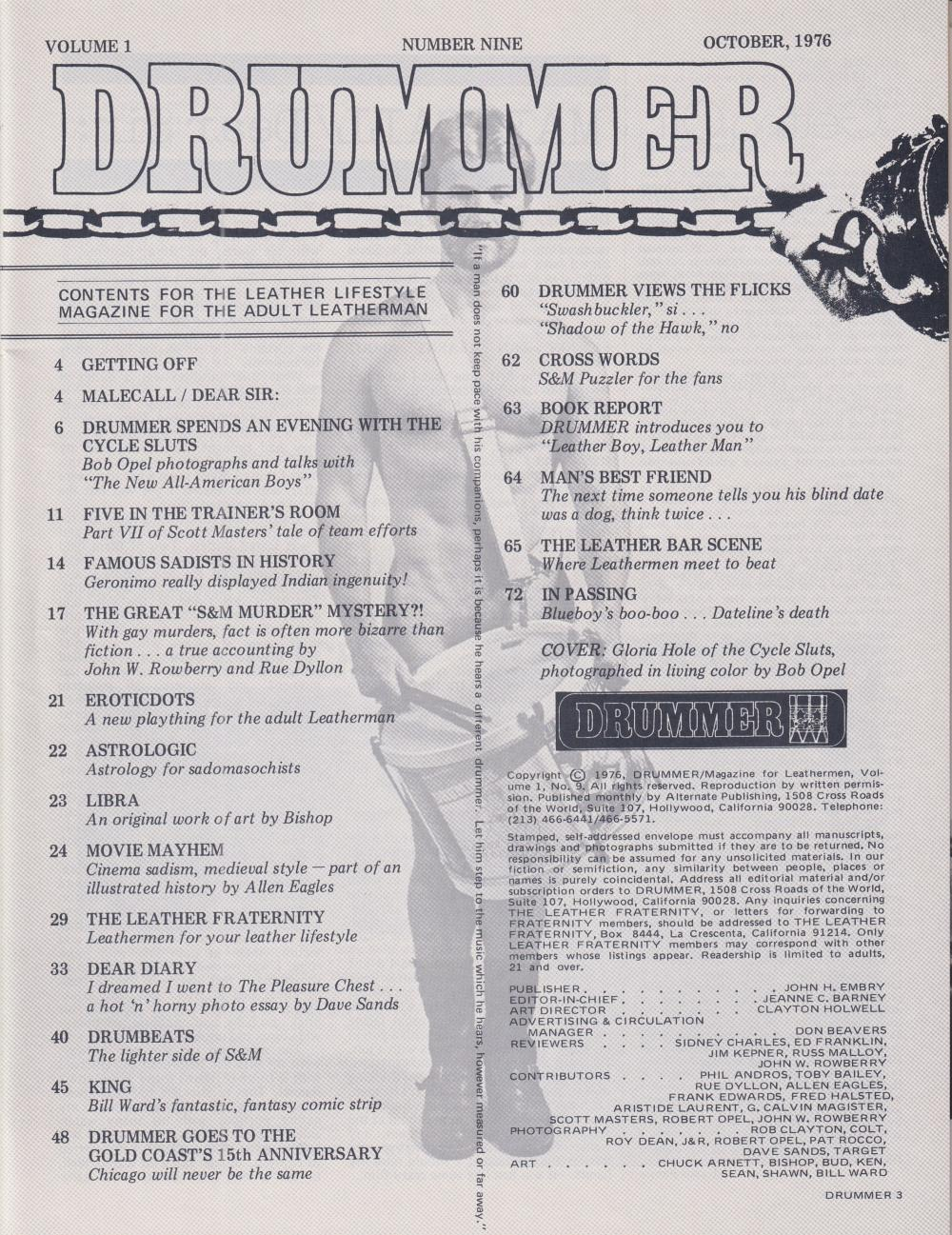
by John W. Rowberry and Rue Dylon
With gay murders, fact is often more bizarre than fiction ... a true accounting by John W. Rowberry and Rue Dylon
D
D
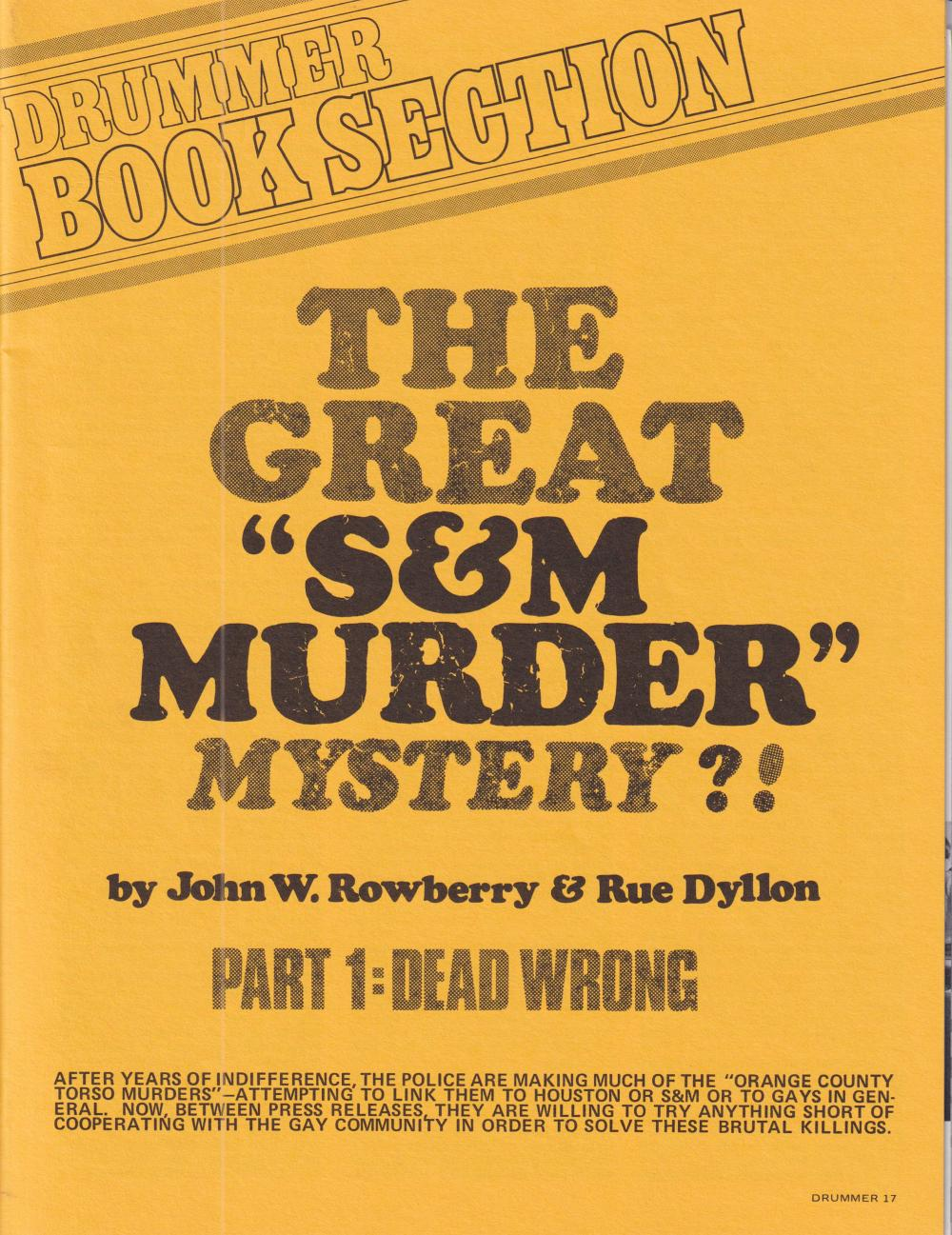
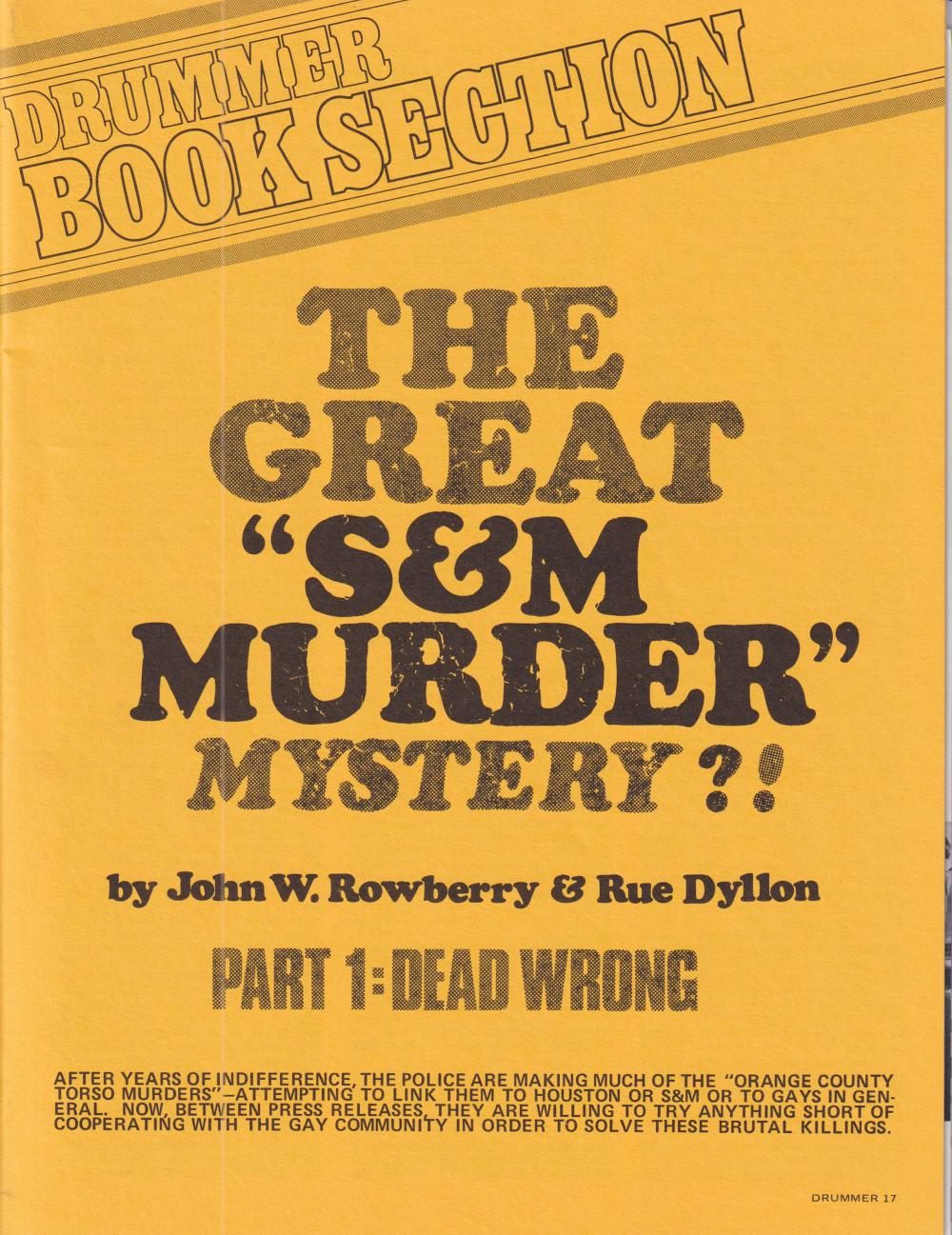
B 79 by John W. Rowberry & Rue Dyllon
AFTER YEARS OF INDIFFERENCE, THE POLICE ARE MAKING MUCH OF THE "ORANGE COUNTY TORSO MURDERS"—ATTEMPTING TO LINK THEM TO HOUSTON OR S&M OR TO GAYS IN GENAL. NOW, BETWEEN PRESS RELEASES, THEY ARE WILLING TO TRY ANYTHING SHOR
FEW GAY MURDERS ARE SOLVED. EVEN WHEN A MURDERER STRIKES AGAIN AND AGAIN, THERE OFTEN IS NO SATISFACTORY WRAP-UP OF THE CASE, NO ARREST, NO TRIAL, NO CONVICTION. AND NO CONFIDENCE IN THE COMMUNITY THAT THE DANGER HAS BEEN
Sex had been on Milt Cohen's mind all
week. It wasn't that he couldn't do his
job - hell, after so many years with the
Los Angeles County Health Department,
he could almost sleepwalk through his
work. Sometimes that wasn't so good. It
left too much time to think.
Milt Cohen wasn't young any more.
Sixty was staring him in the face not too
far down the road, and recent years had
brought him ever closer to an awareness of his own mortality.
He was well-liked, true enough. He was
considered good at his work. Though
generally understood to be gay, neither his supervisors nor his co-workers gave
him any shit about it. It was a harmless
idiosyncrasy in a man who was otherwise more knowledge of his personal life, but not a great deal. He was known to dabble
a bit in S&M, and it was no secret that he
got off on uniforms, especially when they
clothed the young hard bodies of teenage soldiers.
It's a common hangup in gay men,
especially among older individuals who
sense the world passing them by more and more quickly. Milt Cohen came of age
sexually when it was a sin, a crime and a sickness to be "that way." But he lived to see a world where young people took it
naturally. Milt Cohen liked young people.
It gave him pleasure to cater to the
wishes and whims of companions a third
his age. They were, after all, the wave of the future. Theirs was the strength, the
promise, the confidence of fulfilling all that his own youth had been without.
When he smoothed his hands over their
muscled, sunburned flesh, there was a gut-swelling thrill that pounded inside him. When he submitted to their desire for
gratification, when he went down on their
stiff organs, it was youth and strength and life itself that he sucked from their bodies. Until June 12. Sex had been on Milt
Cohen's mind all week. A few minor irritations on the job, a general malaise at the back of his mind — it would all wash
away. He dressed and groomed himself
carefully on Friday night, June 11. Part of the reason for his success in picking up ful about his appearance.
The drive to Oceanside was familiar.
He had made it many times. The Marines
on leave from Camp Pendleton were favorite, fit subjects for his attention, his
need. And, as on dozens of other occasions , when he returned to Los Angeles
in the early Saturday morning hours, he
had company that promised a stunning
weekend.
Cohen was found Monday in his comfortable Hollywood apartment, his skull
crunched by a heavy, blunt object. His missing auto was discovered scant hours
later parked on the street in Oceanside. A
police stakeout operating on the theory
that someone might return to the car
finally gave up and wrote it off.
There are no suspects in Cohen's death.
California gay men are murdered each
year in astonishing numbers. Gay women
don't seem to have the same susceptibility , a susceptibility that authorities
believe stems from the looseness, the openness, the casual encounters that
characterize the sex hunts of many gay
males. The astonishing thing is not that gay men are murdered. In a state where
thousands die violently at the hands of
others each year, a proportionate share of murder victims could be expected.
What is astonishing is that so many gay
men appear to meet their deaths as a
direct result of the expression of their
sexuality, or their attempt at expression.
Few gay murders are solved. Even
when a murderer strikes again and again,
there often is no satisfactory wrap-up of
the case, no arrest, no trial, no conviction.
And no confidence in the community that
the danger has been lessened or contained.
A prime example that seems to hold a
morbid fascination for the Southern California gay community reaches back nearly
four years, to another time of anticipation
during the holiday season of 1972, as
another year was sliding into limbo.
Christmas. It conjures different emotions , different significance in different
people. A commercial, wallet-straining,
party-throwing, boozing and bawdy time of year. Or a nostalgic, lonesome, depres- sing period when the homesickness felt
may not even by for a place or time that has disappeared, but for an idea, a hope
that was never fulfilled. For many, a time
of promise.
For the religious, or those with traditional roots at least, there is the faint
acknowledgement of commemorating the
birthday of a Messiah - a promised hero
who would lead the chosen people from
ignorance and evil into a super-existence
somewhere beyond comprehension.
One thousand nine hundred and seventy-two years after the traditional birthdate of the Christian savior, there
appeared another kind of messiah in the
megalopolitan wilderness of Southern
California. He, like the earlier figure,
would aim at bringing an end to pain and suffering, poverty, illness, despair. But unlike Christ, he didn't offer an infinite
existence of joy and peace. His wasn't a reward of life after death. He offered
death itself.
Christmas, 1972. Edward Daniel Moore
was not very excited about his holiday situation. Twenty years old and far away
from family and friends, the Camp
Pendleton Marine was unresigned to the
prospect of spending Christmas with his
buddies in the barracks. It was a time to
be loved and appreciated, to be shared,
Anything would be better than the
stark military environment. If he were lucky enough to find someone to commiserate with or, better yet, someone willing to share a holiday spirit - a friend
or lover, even - it would lift his spirits. It
was mid-morning when he left the post, determined to hitchhike to the Los
Angeles area, where prospects might not seem so grim.
The messiah rose early the same morning . He performed a morning ritual of
careful shaving, showering, dressing and grooming, wrapped in a frame of mind similar to that of the young Marine. This
day would be special not because of the
presence of loved ones, but because it
augured a customary holiday solitude. The prospect of being alone didn't disturb him; he'd grown used to it over the years.
It was a state of mind he carried with him
inside, even when he was surrounded by
other people.
Still, the possibility of picking up com- panionship for the day - and the night - was attractive. The patterns of cruising
were familiar to him, and he went through
the motions with no apparent urgency.
He shunned the well-known gay watering holes of Hollywood, turning his late- model car down the coast.
It could have been as far south as San
Clemente or South Laguna that they met.
Ed Moore had gotten only short-distance
rides from people rushing through last- minute holiday errands. The holiday had
started early, and long-distance travelers were well on their way by Sunday, Christmas eve.
The messiah's driving was deliberate,
but without a geographic goal. He held to
the main roads, calmly scanning the shoulders, open to possibilites. The request of Ed Moore's outstretched thumb
brought him to a smooth stop. His eyes
were satisfied with the compact, lean frame of the hitchhiker in jeans and
T-shirt.
At first merely relieved that his stuttering efforts to get to the city and seek out
some fun and company were again rolling,
Ed settled back into the shotgun seat.
The driver was companionable, engaging, not unattractive, and seemed to have a
gift for comfortable small talk with strangers. Ed opened up easily.
He was eager for a sense of sharing with someone, and his own smile and
open friendliness were an invitation. It
took scant moments for the two to size each other up as objects of interest; it
took few conversational probes to learn
all that was necessary of each other's situation . Both were spending the day in
search. Both were building an anticipation that this might be what they were
looking for.
Small talk, questions and answers,
jokes, laughter, easy feelings grew
quickly. An invitation to companionship - dinner perhaps, television or a
movie, maybe the promise of grass or
mood-enhancing drugs, the implicit understanding of sexual availability.
To Ed, the chance meeting looked like
an answer to his holiday need, a perfect answer to the question posed by his leaving the base. To his older host, the chance
meeting had the perfection of fate.
As they pulled into the driveway of the messiah's house some time later, Ed
was casual about revealing that he had a
IT PROBABLY TOOK ONLY A MOMENT FOR EDWARD DANIEL MOORE TO DIE AFTER THE GARROT-ING BEGAN, IT MUST HAVE SEEMED AN ETERNITY. THE MESSIAH HAD FULFILLED HIS DESTINY AS
HAD ED. THEY WOULD BE LINKED FOREVER BY THE ACT THEY HAD SHARED. IT HAD BEGUN. few days before having to report back to
Pendleton. He was obviously open to an
extended experience with this new-found
friend, whose masculinity and reserve matched well his own liking for a male
The house was in a quiet setting,
almost secluded from the hustle of cosmopolitan life. The messiah knew very
few of his neighbors and was not inter- ested in knowing any more of them. He had few visitors, and they were almost
exclusively the gays he met in San Diego or Long Beach bars, sometimes from the
L.A. leather strip places, frequently just
hitchhikers. Like Ed.
The surroundings were appropriately simple, almost spartan. His wasn't a frilly
life, romantic and sentimental, laden with
mementoes. He worked, traveled a little,
exercised a lot, knew how to hammer and
nail, and occasionally added a slick magazine of hard, naked men to the smallish
collection in his bedroom closet.
He was a loner. Certainly not a gay
activist, his lifestyle was in fact not very
gay at all. He didn't think of himself that
way, he divorced his sexual leanings from
any ideas of politics or bias. He was a
man, that's all, with specific, uncompromising wants and tastes in other men.
He had no special awareness of himself
as different until just recently, and the
difference centered not on his sexuality. but on the destiny of his relationship to
others. Whether from a growing, subtle
awareness, or from a blinding revelation,
the messiah adopted a purpose for his life.
The conviction may have come in the
throes of sexual climax; it may have been
acted out immediately, or it may have laid like an uncomfortable, guilty secret for some time before its inevitability was
clear.
Christmas, 1972 was the hinge, the pivot, and Ed Moore was the first.
Ed had a casual way, able to make himself and others feel relaxed in any situation . His laid-back attitude extended to
the comfort he felt in his own sexuality,
and the ease with which he acknowledged
to himself that he wanted this man.
To move matters along, he asked if he
could shower and freshen up. Stripping
off his clothes turned them both on, but they remained cool about it until Ed
emerged from the steamy bathroom, his body glowing from the fresh water and rough toweling. The messiah, controlled
and confident, greeted the young guest with a smile and an open beer. Remaining fully dressed himself, he let his eyes tout the taut planes and lean contours of the
Marine, who tousled his still-damp hair
with a towel in one hand, while tipping the brew to his lips with the other.
Ed sat down in jockey shorts, continuing the easy conversation with his host. He was ready, and he knew the older
man was ready from a glance at the man's
groin, but he continued a while to tease
subtly across the space of the living room,
slouching down into a cushioned chair,
letting his muscular legs fall wide, feeling more than seeing his own penis stir and
stretch and swell.
The cool and quiet appraisal of his
body from the other man turned Ed on
more and more, and when he rose at the
invitation to share a joint on the leather sofa with his host, his erection was obvious. Another beer was opened, tasting
colder, biting after the harshness of the
marijuana. A second joint was shared as late afternoon passed into early evening,
and winter darkness closed out the world.
The conversation had slowed, sometimes halted for long moments, and imperceptibly the messiah had come into
control of the situation. It was the young
Marine who was being teased now, taunted with the desire for his own sexual relief
while the older man seemed to circle
around it.
The host had gone so far as to unbutton
his shirt, pull the tails out of his Levis and
unbuckle, but he did not remove his belt or open his fly. He had watched the Marine drop his cupped hand casually
over his own swollen groin in suggestion,
but knew that the young man would eventually make the decisive move himself .
Having established his own strength
and detachment, the messiah knew his
disciple would reach out to him, come to
him, appeal for his blessing, his favor, his
teaching. Ed would slip down off the sofa,
kneel before his host in supplication and
desire, ready to serve. The messiah would
be unmoving, letting the youth reach out, touch, explore what visible flesh presented itself, letting his need for consummation build.
Certainly the roles between them were
cast by that point. It would be the messiah who decided what pleasures were
to be met, and how.
Ed probably allowed himself to be tied
willingly. There is nothing to suggest he
was forced. It is positive that he was tied
at the wrists, then at the ankles. Lying on
the floor, or on the bed, hands bound behind his back, Ed was powerless when the messiah pulled his pants down around his
knees and grabbed a fistful of the Marine's pubic hair.
Perhaps Ed made sounds of pain; perhaps not. But when the messiah took his
captive's penis in his mouth and scraped
his teeth down its stiff length, leaving angry scratches where the blood rose, the
Marine must have flashed on the danger, the vulnerability of his position.
Perhaps he struggled to release his
flesh from the bite. Surely when the
messiah took the young boy's tender testicles in his mouth and clamped down
on them in cannabalistic fury, Ed
screamed. A sock shoved in his mouth
was enough to silence, almost gag, him.
The biting and scraping would continue until the Marine's once-proud organ was reduced to a shrinking, bleeding object.
The messiah turned the crying, choking body over and grabbed a fistful of ass,
pulling, scratching, slapping, watching the muscles react to the brutual manipulations . His fingers dug at the rectum,
pulling at the soft tissue like an animal rooting for food, forcing their way into the cavity. Blood or excrement made him
grab the other sock from the youth's shoes and stuff it into the opening.
It was becoming too difficult, too unrewarding , perhaps too soiling. It would have to be ended. Another piece of rope was looped around the boy's neck, now trembling and corded with fear. The skin
pinched as the rope was drawn tight. Then the coughing and spitting began. A choking torrent of beer and stomach acid
forced the sock from the young man's
mouth, but he was beyond the ability to cry out. The messiah jerked on the rope
in anger. The neck turned red, and blood
began to exit from the twisted mouth
of the victim.
It probably took only a moment for
Edward Daniel Moore to die after the garroting began. It must have seemed an eternity. For the messiah, it was time
enough to produce a raging erection that he loosed from his pants and pulled at frantically with one hand while continuing to twist the rope in the other. It was
And it had begun.
The messiah had fulfilled his destiny as, in fact, had Ed. They would be linked forever by the act they had shared.
On Christmas night, as thousands gathered in churches and homes to renew their celebration in the Christian Messiah,
the other was retracing his route, an un- wieldy bundle wrapped in a sheet on the
car seat beside him. His first thought was
to leave the body on the shores of the
ocean, returning man to his probable place of origin. But if the tide swept the
body away, no one would know the messiah had come. To be acknowledged,
the offering would have to be more
visible.
The Seventh Avenue off-ramp of the
405 freeway was deserted. The messiah
slowed, then stopped his car. Opening the
passenger door, he had only to propel the body toward the roadside, holding onto
the ends of the sheet. The young victim
was found a day later, clothed in jeans and shirt, a stocking still lodged in his anus. Police would be able to identify
him, but not his executioner.
The messiah would wait 40 days before
he went in search of another disciple. He
would have time to contemplate his actions. He would know of his first vic- mission, the messiah would follow the same pattern: an easy surrender of the victim to his executioner would make
possible an exact duplication. The 18- to
20-year-old's body was discovered naked in the brush near the Terminal Island freeway exit in San Pedro.
Gays in the Long Beach area questioned
by police and shown a photo of the victim indicated he looked familiar, but
his identity would not be established. The
IT MAY BE SUSPECTED THAT THE THIRD RITUAL LEFT SOMETHING UNSATISFIED OR NAGGING IN
THE EXECUTIONER'S MIND. UNLIKE THE EARLIER DEATHS, IT HAD BEEN FAR MORE ABUSIVE. THE
DEMANDS OF THE FORCE INSIDE HIM REQUIRED THE MESSIAH TO ACT AGAIN WITH LITTLE PAUSE. second death was February 5. It was more
than two months before the third venture , and by that time the ritual had apparently gained new tenets, new twists to
the covenant of death. The messiah, the
angel of destiny, had grown in his needs, and the next disciple was to be found in
a setting where the likelihood of attuned personalities was greater.
In a biker bar in the South Bay, he
picked up a young man, probably underage. Dressed in a sleeveless, collarless Levi
agacket and jeans, the youth apparently went willingly at the prospect of sexual excitement. He, too, was unidentifiable when police found his body April 14 in Huntington Beach though, again, Long Beach poole who saw his p
cated he was familiar in the area.
New to the pattern was a blow on the
head - the disciple may have been less
pliable, or had a change of mind at some
point early in the game. No matter. Once subdued, he too was bound and gagged;
but the violence done to his body, the
mutilation, was heightened. Perhaps the messiah's fury was kindled by resistance.
The third victim, believed to be 16 to
20 years old, was stabbed repeatedly in the stomach and chest, and knife wounds
were also found on his arms. Finally, he was castrated.
It may be suspected that the third
ritual left something unsatisfied or nagging
in the executioner's mind. Unlike the earlier deaths, it had been far more abusive. The demands of the death force
inside him required the messiah to act what had become a lust for total defilement of the human body. Eight days after
discovery of the third crime, Los Angeles
police began finding heavy gauge, green plastic bags in the vicinity of the Term- inal Island freeway spur. One contained
two arms from shoulder to wrist - no
hands. Another held a right leg, severed
from its body at the hip. A third contained a stubby torso, minus head and
limbs.
That was April 22. It was another
three days before the left leg was discovered behind a Sunset Beach gay bar.
The following day the severed head was found in a load of waste paper at a Gar-dena recycling yard. A final bizarre fillip: the eyelids had been cut away.
Hands and genitals were never found,
but authorities determined that the vic- tim was again about 20 and had died of
strangulation. Like the previous three, his identity remains a mystery.
* * *
Three months passed, and some
authorities believe the first chain ended at
that point. But a fifth body was found July 30 in an ice plant not far from where
victim number one had been dumped.
This time there was a positive identification - 20-year-old Ronnie Wiebe of Los
Alamitos.
Not known to be gay, Wiebe had gone
out drinking at the Sportsman on Friday
night but left just before closing time. His
car was found in the bar's parking lot the
following Monday morning, the same day his clothed but mutilated body was
discovered.
Examinations indicated he had been
subjected to torture, and had suffered
numerous cuts and scrapes before being
strangled. A stocking was stuffed in his
anus. Police believe he was killed elsewhere and brought to the ice house already dead.
The similarities to earlier crimes were
too obvious. A copycat killer? Some details of the earlier killings were repeated , authorities said, even though they
had not been publicly disclosed. Once
more there was a respite, though, in the
discovery of victims. If one executioner
was responsible for all, he was either growing sated or was concealing his victims well.
It wasn't to last. Vincente Mestas, a
23-year-old Long Beach State student disappeared from his apartment December 26 after remarking to a roommate
that it would be nice to spend part of the
holiday break in the mountains. Both his
car and motorcycle were left behind, and
authorities believe that he probably went
out only for an evening walk to the bluffs, a popular nighttime cruising area
little more than three blocks from his
apartment.
But his body was discovered many
miles distant, in the foothills of the San
Bernardino mountains, by hikers three days later. The retreat he had spoken of
for relaxation had developed into a
hellish, tortured death, almost a year to the day after the first murder. Mestas' head was shaved, his penis and
testicles battered by a rock, his intestines
ruptured by the forced intrusion of a
blunt weapon. He was cut extensively on his back and buttocks, and there were burns about his neck. His end came by
strangulation, but the ritual continued: the murderer cut his nipples from his chest, then hacked off his hands and tied
the bleeding stumps of his arms into
plastic bags.
Did the messiah spend the next six
months reliving, deliberating, meditating
on his achievements? Did he analyze the
turn his life had taken, trying to understand his brutal drives and compulsions?
Did he find roots in his past, in his mind for the violence that exploded against ap- parently willing sexual partners? To this
point, there is no disclosed evidence that he achieved any sexual climax in partner- ship with the victims. They were mere
accessories to his passion, the objects of
his ultimate conquest.
It was six months before a seventh
victim was discovered, on June 2, 1974. Malcolm Little, a 20-year-old trucker from Selma, Alabama, who was visiting a brother in Long Beach, announced he was hitchhiking home after a long-distance argument with his girl fr by telephone on May 27.
His brother set him out on the Garden
Grove freeway near the San Diego freeway interchange, and he put his thumb
up. His nude body was discovered tied
between tree branches, his legs propped up and spread wide. The scene of his
death was a deserted area near the Salton
Sea in Imperial County. His murderer had apparently failed to achieve anal sex with him, and had furiously rammed the
boy's ass with a tree branch, castrated
and strangled him.
If the same killer was guilty in all these
instances, it may be that the urge toward
the act of sodomy was developing into a
violent compulsion he could no longer resist or control. Twenty days later, an
eighth victim was found, naked and strangled, dumped down a South Laguna hillside. There were bite marks on his penis and nipples, and he had been sodomized.
He was Roger Dickerson, an 18-year-old Marine who had been last seen alive
drinking with a couple of Marine buddies
in a San Clemente bar on Friday, June 21. He told them just before leaving that he
had gotten a ride into Los Angeles. It was
apparently his last.
Number nine was Thomas Lee, 25,
found strangled in a Long Beach oil field Saturday, August 3. He had been last seen by friends in a South Bay bar the previous
night and reportedly left with a stranger in his late 30s, graying, the driver of a 1968 or 69 Chevelle.
Number ten was James Reeves, 19,
who met his killer on the rebound from problems with his family and his lover. On Thursday, November 28, he had Thanksgiving dinner with friends at an event sponsored by Metropolitan Community Church at the Orange County
Gay Community Center in Costa Mesa.
He left alone after helping to clean up
the dinner dishes.
His car was found abandoned the next
day in Granada Park, part of the Belmont Shores area of Long Beach. Miles away, on a remote road near Irvine, his body
was discovered, dressed only in a bloody
T-shirt. Once again a branch had been shoved into the victim's rectum. The
cause of death was listed as suffocation.
Newspaper reports stated incorrectly
that Reeves had been anally assaulted with a surveyor's stake. The killer made them prophetic when he rammed just
such a 1-by-3 inch stake into the anus of
his eleventh victim, possibly after reading the erroneous accounts. Dead was 17- year-old John Leras, found nude in the
surf near Sunset Beach on January 3, 1975.
The executioner again had struck near
the anniversary of his series of crimes.
But of the eight police jurisdictions that
have become involved in the bizarre cases,
there is little agreement on investigations,
suspects, motivation, even whether the crimes are interrelated. All 11 have come to be known as the "Torso Murders,"
Continued on Page 53
WITH MISINFORMATION RAMPANT, PERSONS IN THE COMMUNITY WHO MIGHT WISH TO ASSIST ARE
DISCOURAGED BY A MAZE OF CONFLICT AND A WALL OF RESISTANCE BY AUTHORITIES. THE LOS ANGELES POLICE DEPARTMENT HAS BEEN CHARACTERIZED AS HOSTILE BY THOSE TRYING TO HELP.
LOS
Continued from Page 20 though not all were cut up. All have been referred to as the "Orange County Mur- ders," though several occurred elsewhere
And the authorities are growing increasingly reluctant to talk about the crimes. While at first apparently willing and anxious to enlist help from the gay
community in finding and tracking down
leads, an atmosphere of suspicion and notable lack of cooperation have
shriveled that approach.
There have been additional deaths in
the past 18 months, and some law en- forcement sources speak darkly of 15 to
18 unsolved and possibly related murders.
But both Orange County and Los Angeles County sheriffs and police departments have backed away from discussing any
details of the crimes, or the investigations
which have been conducted. Most of the files gather dust.
Even the details recited here are not known to be totally reliable or accurate,
since they are compiled from other reports as the crimes occurred, and from
summaries which have appeared in several
gay publications previously. Within any
given published report, discrepancies have
sometimes been apparent, and authorities
have so far declined to sit down with responsible people in the gay community
and confirm or deny aspects of the cases
which by now have become ragged with
rumor.
With misinformation rampant, persons in the community who might wish to
assist are discouraged by a maze of conflict and a wall of resistance by authori-ties . District attorney offices in both counties have declined to talk about the cases, and Los Angeles Police Department detectives have been characterized that the LAPD is currently most active in the case. It is said that Los Angeles
leather bar owners have been intensively
questioned, as have operators of businesses which supply the clothing and "toy" fetishes of S&M practioners.
It is said that the unsolved murder
series is at the root of the continuing police attention that is directed at gay bars in Hollywood and Rampart police
divisions which cater to leather and S&M fancies. There are even reliable indications that the infamous Mark IV bath
house raid, in which a task force of more
than 100 Los Angeles officers swept up a charity "slave auction" in April, was an
outgrowth over suspicions that were
rooted in the murder cases.
It is said that suspicion has touched on
well-known professional people who are
tied up in the gay business conglomerates
which own and operate bars, baths, discos, even publishing ventures.
It is said that a local actor, a gay man
who graduated from prostitute to pimp to procurer and finally to business associate in some high deals involving local clubs, was a prime suspect before his own
disappearance and death.
It is said that on two occasions
authorities thought they had the goods on
a suspect who might have been the killer,
and who had carelessly permitted other victims to escape. But the potential victims , the would-be witnesses, all seemed
to disappear or lose their memories before a case could be constructed and
charges brought.
The "messiah" angle is itself no more
than a theoretical projection based on
psychological conjecturing. No one knows the truth of the last hours of Ed
Moore except his killer, and the narrative presented here is only one of many
possible actualities.
The entire series of incidents (and
there may well be others which either have not come to light or in which the
victims escaped) raises many more questions than there are answers, and the questions seem to draw investigators into a more and more tangled web of
interconnections.
At present, all 11 murders, like the unrelated death of Milt Cohen and numerous other gay victims, remain unsolved. To explore all of them is impossible in
print, but pursuing a few of the byways
may give gay people an idea of the
dangers they face, and the way in which law enforcement affects them.
12.
*
*
His body is found in Texas. It is some distance off the freeway and only partially clothed. It is apparent to authorities
that death was as much a result of exposure to the unrelenting Texas sun, the harsh winter wind, the dust-dry scrub that he tried to crawl through in order to
find help — as much those as the knife
wound deep in his chest.
The stabbing alone would have been fatal, eventually. No doubt there. But
perhaps if he had been found earlier, if he
had not been so far from the hum of civilization flowing down the freeway, if he
had not chosen to play out his sexual
scene in the shadows of a willowy oasis off the road … He might have been found alive. He
might have identified his killer. He might
have given a description of the car he had
been driving, the car that was never reported missing or stolen, the car that was never found. He might even have lived
somehow, rushed to intensive care in a
not-too-distant hospital.
But no. There the body lay, where its last strength had dragged it, halfway up
the dusty pair of tire furrows that led from the isolated clump of weathered willow to the dirty gravel access road, a mile from where it turned off the secondary highway which was Perry's exit from
the freeway.
His exit from life.
His smart, French-cut jeans are tangled around his lower legs. His buttery
Frye boots are scraped and scuffed and
heavy with blown dust. His back is burnt
red beneath the same grime. His Western-yoked linen shirt with the quilted design on the shoulders lies behind him, under
the trees - but his chest and belly, his
arms and face
The dried blood that spread from the
wound, the sweat from exertion toward
reaching help, the sweat of death, the bits
of rock and twigs that clawed his body as he tried to move, all dried with the gritty
wind into a mask that coats the face and
torso, that hides the handsomeness, betrays the once-hard, proudly attractive body.
The specualtion of authorities is curt, unembroidered. It is likely, they say, that
the victim was stabbed by a stranger,
probably a hitchhiker to whom he had
given a ride before letting him know that
he would demand a sexual favor in payment . There was human excrement on
the victim's penis, sperm traces in the ducts.
There was little sign of a prolonged
struggle, so it is likely the sex-play took place quietly, if reluctantly. The subse- quent attack was most likely a sudden
turning, revenge in the moment of ecstatic vulnerability.
For Perry Paulding, an ironic accident.
* * *
Going home was a good idea. Back in
Oklahoma, Perry Paulding was a minor celebrity. Not that he was recognized on
the streets, or talked about in the clubs or
under hair dryers. He wasn't a star to the
general public, but he was known.
He had been mentioned more than
once in the Tulsa Tribune, for accomplishments at college, for min or league theater efforts, finally, his mother had told him, for his "making it" in Hollywood, his big breaks on the silver screen. Even the Oklahoma Journal had carried a piece
about the local boy making good – just a few paragraphs, to be sure, but in the Oklahoma City Paper!
That was nearly five years ago, in 1971. A lot of water had gone over the dam since then. His reputation and stature had
grown in Hollywood, but not in the way
PERRY PAULDING DID NOT HAVE THE OUTRAGEOUSLY HANDSOME LOOKS THAT MIGHT EARN HIM
A SECOND GLANCE FROM AGENTS OR PRODUCERS. WHAT HE DID HAVE WAS A DETERMINATION, A
ESPECIALLY THE BEDROOM EYES.
SEXY BODY, A CONFIDENT PRESENCE AND BEDROOM EYES. he had once dreamed. Not in the way his
mother thought. Far from the way his
father had once hoped, when there was
still the possibility that Perry might have some sort of medical career.
Perry was a long way down the road from that now, but his family need never
know. At any rate, he thought as the late- model car ate up the miles beneath him,
that was something he preferred to put
out of his mind for the present. That was why he had left L.A., why he was now
rushing through the parched New Mexico
wastelands, rushing toward Texas, toward
Oklahoma, toward home.
A rest for a few weeks would do him
good. He needed to let things settle back
in the city. Tempers had been running high in the powerful circles Perry had
joined. More to the point, it was becoming harder and harder to dodge the questions , the official inquiries, the investigations over little things that could too easily lead to big things.
Cooling off would be good for every- one, Perry thought. I might even leave the whole situation behind. Hell, I don't need
that scene. I could always go back to New
York - pick up my acting career, or maybe even go back to school. Mom
would like that.
In his daydreaming, Perry saw himself
auditioning for a Broadway show — and making it. Not as a star right off, of course. Perhaps first as a walk-on, or even
an understudy. He could imagine filling
in for the other actor after sudden illness, and knocking the critics dead.
He could imagine reading his name in the Times, in the New Yorker, in the Vil-
lage Voice. He could imagine it though he
had never read any of them before. He
could see himself commanding a table in
a swank restaurant, shopping for expensive clothes on Fifth Avenue, supervising the decoration of a new apartment off
Central Park.
Now that he was into it, he could imagine himself in After Dark, photo- party, or on Fire Island.
(His mind brushed aside the reality
that he knew nothing about the Hamp-tons , that he had been ot Cherry Grove
on Fire Island only once, and then as a paid companion, a boy-on-a-leash whose
assignment it was to let everyone envy his
master's taste first, then submit to a gang
orgy that frightened and thrilled him all
thrilled him because it
at once frightened him.)
It was apparently irrelevant, or for- gotten in Perry's daydreaming, that he hadn't really liked New York at all.
While he was studying medical tech- nology there, he had hated the city, its extremes of heat and cold, its dirt and
disintegration. He had even, at first, hated the openness with which sex was
pursued, the openness that made his
Tulsa background quiver with dread and a simultaneous longing for abandon. He had found the Village, and then the Village found him. He had found his sex- uality but not really come to terms with
it. He had learned for the first time that
he need never be completely down and
out, so long as he groomed himself well
and feigned response to those who found
his youth desirable.
But he didn't want to be commanded.
He wanted the reins in his own hands.
New York was too big; too many people
with too much knowledge, too much of a head start on Perry. He was out of his element, unable, this time, to adjust. Back in Oklahoma, his schooling
completed and his days occupied by work
at the Hillcrest Hospital Laboratories,
Perry began to feel the outlines of what
New York had taught him. He began once
again to be restless. He began to covet his
high school show business dream. And he
began to stir with the desire for esexual
power.
That was a seed that New York had
planted. Speeding east from Tucumcari,
plunging across the state line into Texas,
marked by a stone plinth bearing a wel- come, Perry began to feel horny.
Reactions slowed by the fog of his thoughts, Perry was half a mile down U.S.
66 past the solitary figure with its upraised thumb before he ground the car to a halt, jammed the shift lever into reverse,
and spun gravel as he backed along the
shoulder to meet the lanky hitchhiker
who was running up behind.
Thrusting open the passenger door
with his best professional smile, Perry
watched appreciatively as the youth
wrestled a military green duffel bag into
the back seat. The pick-up ducked his sun-tanned head of short-cropped blond hair
into the front, dropped narrow hips into the bucket seat, and shrugged the strain from his shoulders.
Perry's brain hardly noted the quick, smiling exchange of names and travel
goals with the stranger. It was fastened instead on the deep breath heaved by the man's muscled chest, a breath that swelled taut under the snug white tee
shirt and began a swelling in Perry as well.
This, Perry gloated, could very well be
* * *
His body is found in Utah. A pair of heads, vagabonds in their custom van,
stopped along the highway between Salt
Lake City and Provo to eat some lunch
and roll a joint. Random exploring off
the road brought them across a dry
stream bed. The body is there.
Fully clothed, neat, strangled. There is
no sign of a struggle, no disarrangement,
no wounds, nothing telltale to be scraped
from beneath the victim's fingernails. He
evidently knew his attackers and was taken by surprise.
Because of the way the body reclines, and because of the absence of marks
where it might have been dragged, author-ities assume that he was murdered elsewhere , then carred here by at least two
persons. The victim is six feet tall, black
hair, blue eyes, nicely built, around 30.
A premeditated assualt. Determined.
As if it were fated, an inevitable outcome
of the life and deeds of the parties involved . Not an act of passion, but possibly of preservation. A necessary execution born of the desperation felt in
threatened men.
For Perry Paulding, a dramatic role reversal.
Los Angeles was getting too hot. Too many things were happening too fast. Perry could scarcely remember these
days when the living was easy, fun, exciting . When the future stood open before him like a gently rising road, with gardens
and golden light at the top.
Now the road seemed to lead down
into the rocks, grow narrower each day
between dangers that were closing in, opposing forces that could, either one, destroy him. Was that a chasm yawning ahead? Were there no side roads leading away?
Perry's dreams were troubled, to say
the least. He had good reason to be ill at ease. But it had all happened so gradually.
It had all seemed so right at the time, so
easy. Before the nagging fear had come the sense of power, of control, of invincibility . His life, though far different from
anything he had imagined as a youngster or a college student, had had a sense of
destiny about it.
It was the life that belonged to him by
choice, and he had little awareness that
the real controls were in the hands of
others. Seen through the prism of passing
years, even his distant show business splash was bent out of the shape of reality, as if Perry had created it himself.
It had, in fact, fallen on him by a quirk. He had come to Los Angeles, to the glamour capitol of the world, with less than the usual credentials for "making it." A thousand other would-be stars
could claim more experience, more training , more actual credits in high school
and college drama, community theatre.
His was no exceptional voice, no stunning
talent.
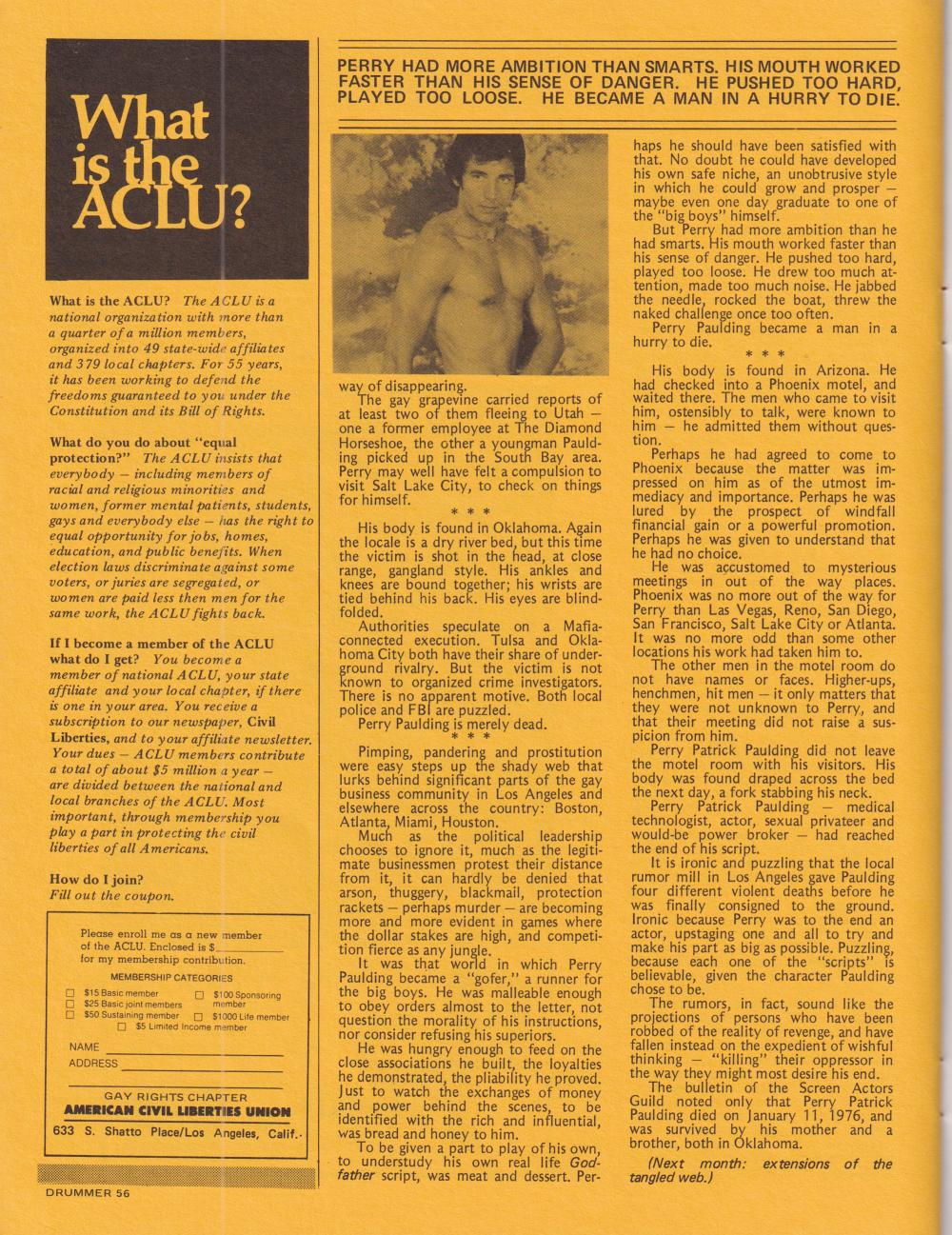
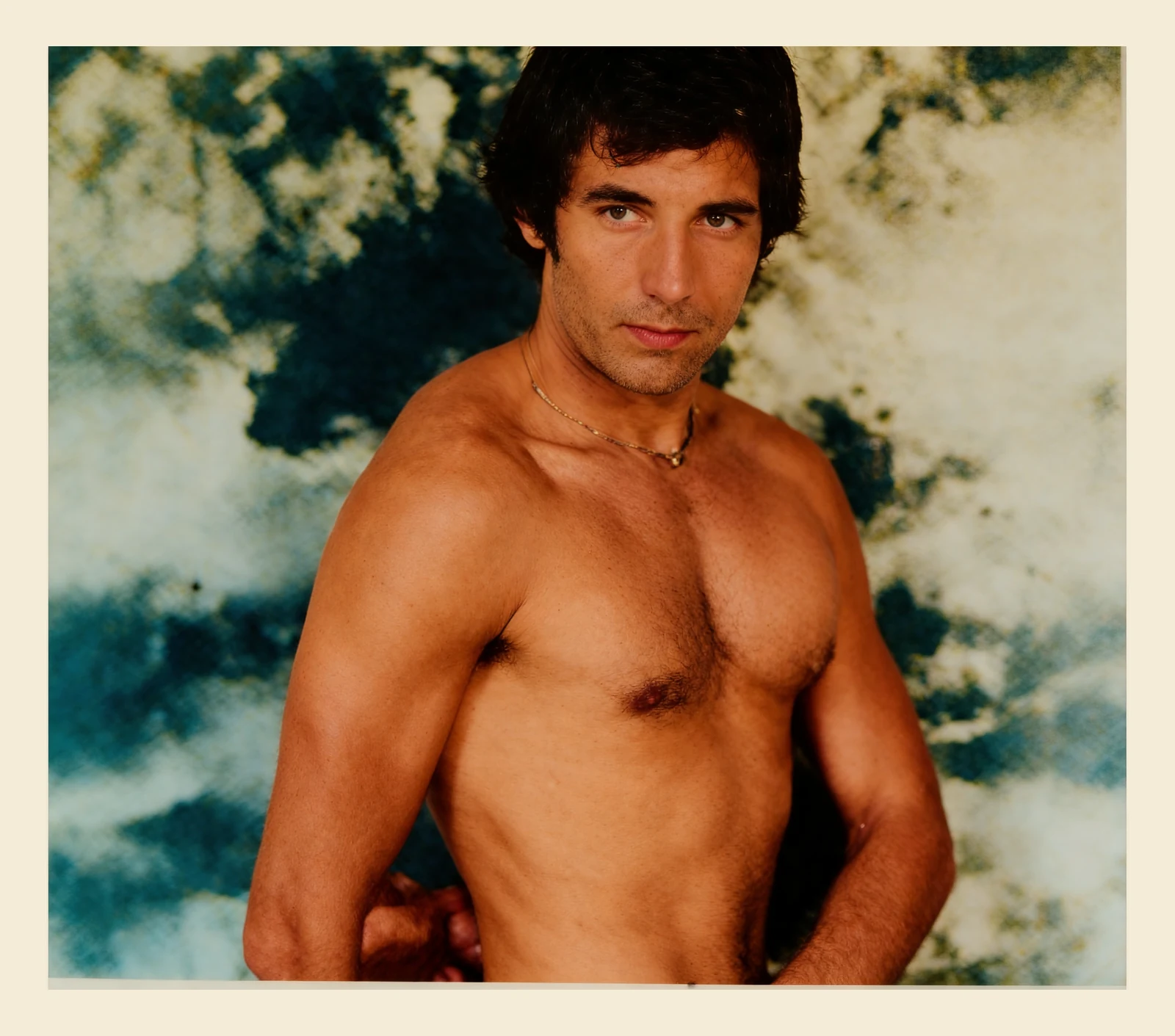
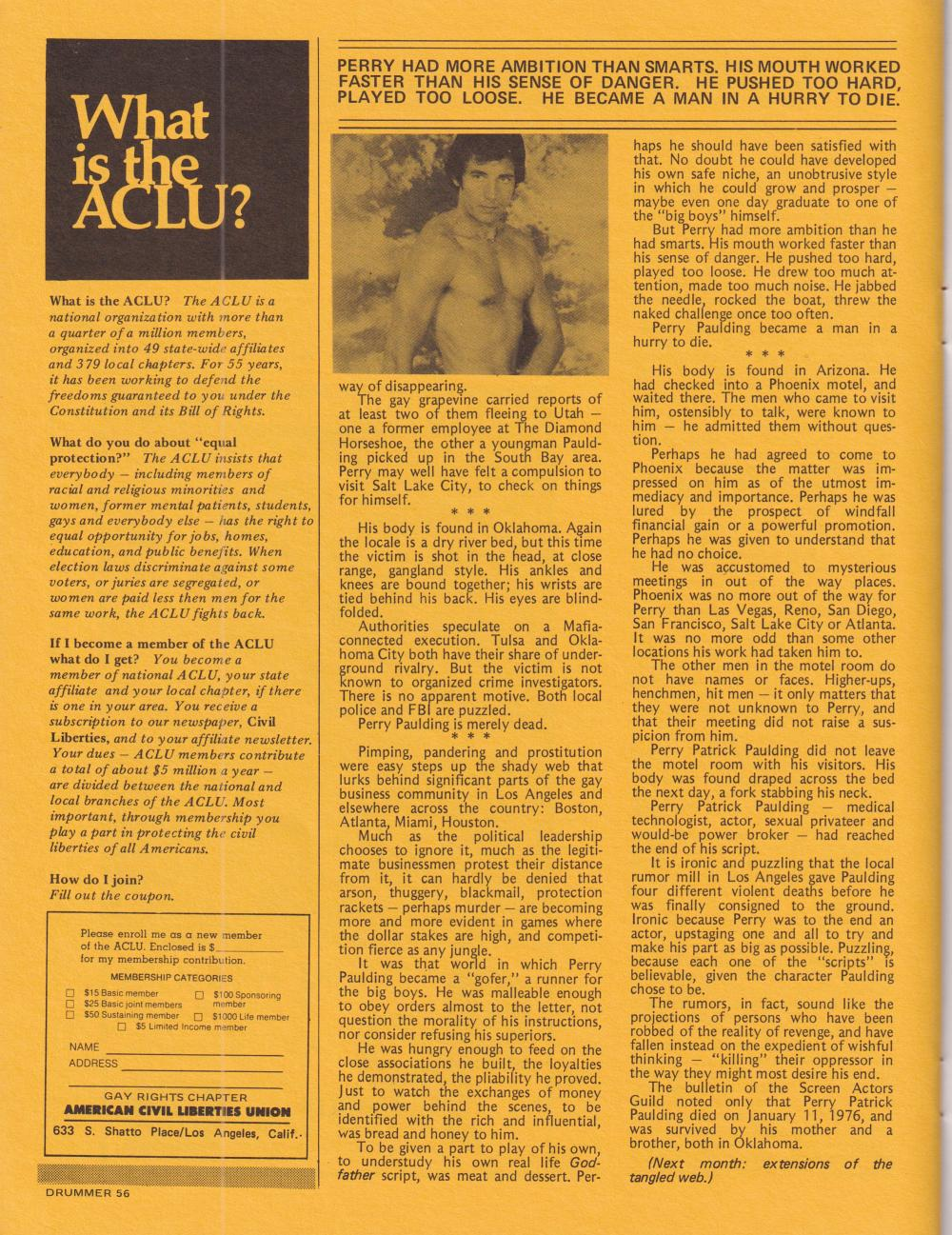
He did not even have the outrageously
handsome looks that might earn him a
second glance from agents or producers.
What he did have was determination, a
sexy body, a confident presence, and bedroom eyes.
Especially bedroom eyes.
That single feature was probably what tipped the balance for Perry to win him
his first significant movie role. He had
made the rounds like the other hopefuls,
had gotten a composite of photos shot and printed, had circulated his creden- tials, such as they were.
The composite was standard cliche Hollywood. Besides the handsome, smiling portrait, full size on the front, there
were three smaller photos on the reverse
- one showing a collegiate Perry Paulding in sweater and slacks, sport coat slung
across one shoulder. The second showed
Perry hunkered down behind a six- shooter, his good looks topped by a cowboy hat. The third showed Perry where
he really thought it all was at: in brief
CASTING COUCH RUMORS WERE WELL-KNOWN TO PERRY, AND HE WASN'T ABOVE TRYING TO CATCH
THE EYE OF A CLOSETY INDUSTRY INSIDER BY SHOWING A LOT OF SKIN. HE FOUND HIMSELF UN-SUITED TO WORKING HIS WAY INTO STARDOM BETWEEN THE SHEETS—HE FOUND IT TOO PASSIVE. swimming trunks, his muscles frozen into
a physique pose.
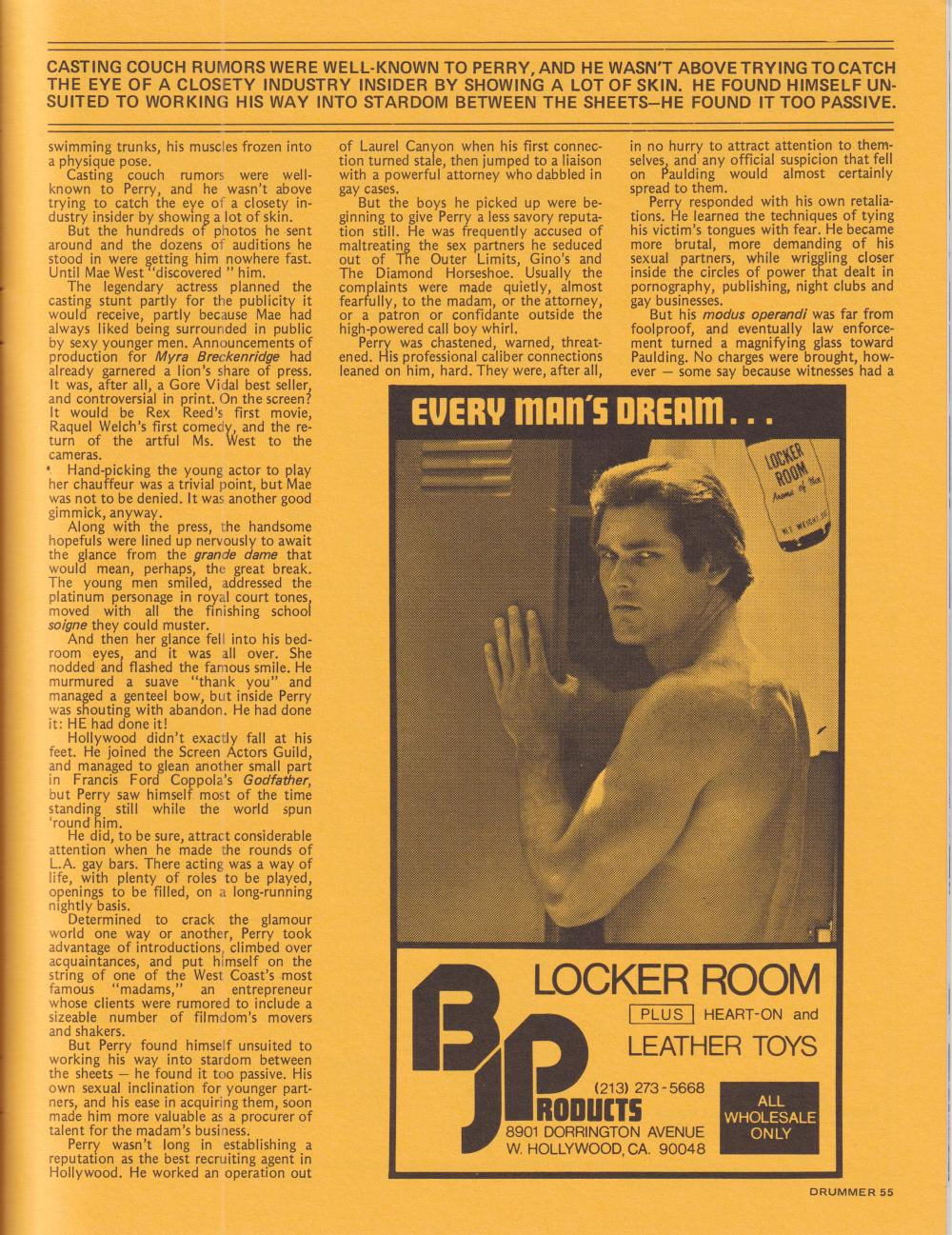
Casting couch rumors were well-known to Perry, and he wasn't above trying to catch the eye of a closety industry insider by showing a lot of skin.
But the hundreds of photos he sent around and the dozens of auditions he
stood in were getting him nowhere fast. Until Mae West "discovered" him.
The legendary actress planned the casting stunt partly for the publicity it
would receive, partly because Mae had
always liked being surrounded in public
by sexy younger men. Announcements of
production for Myra Breckenridge had
already garnered a lion's share of press. It was, after all, a Gore Vidal best seller,
and controversial in print. On the screen? It would be Rex Reed's first movie, Raquel Welch's first comedy, and the return of the artful Ms. West to the
cameras.
Hand-picking the young actor to play
her chauffeur was a trivial point, but Mae
was not to be denied. It was another good gimmick, anyway.
Along with the press, the handsome hopefuls were lined up nervously to await
the glance from the grande dame that
would mean, perhaps, the great break. The young men smiled, addressed the
platinum personage in royal court tones, moved with all the finishing school
soigne they could muster.
And then her glance fell into his bedroom eyes, and it was all over. She nodded and flashed the famous smile. He murmured a suave "thank you" and
managed a genteel bow, but inside Perry was shouting with abandon. He had done it!
Hollywood didn't exactly fall at his
feet. He joined the Screen Actors Guild,
and managed to glean another small part in Francis Ford Coppola's Godfather,
but Perry saw himself most of the time
standing still while the world spun
round him.
He did, to be sure, attract considerable
attention when he made the rounds of
L.A. gay bars. There acting was a way of life, with plenty of roles to be played, openings to be filled, on a long-running nightly basis.
Determined to crack the glamour world one way or another, Perry took advantage of introductions, climbed over
acquaintances, and put himself on the string of one of the West Coast's most famous "madams," an entrepreneur whose clients were rumored to include a
sizeable number of filmdom's movers
and shakers.
But Perry found himself unsuited to
working his way into stardom between
the sheets - he found it too passive. His
own sexual inclination for younger partners , and his ease in acquiring them, soon
made him more valuable as a procurer of
talent for the madam's business.
Perry wasn't long in establishing a reputation as the best recruiting agent in
Hollywood. He worked an operation out of Laurel Canyon when his first connection turned stale, then jumped to a liaison
with a powerful attorney who dabbled in
gay cases.
But the boys he picked up were beginning to give Perry a less savory reputation still. He was frequently accused of maltreating the sex partners he seduced out of The Outer Limits, Gino's and The Diamond Horseshoe. Usually the
complaints were made quietly, almost fearfully, to the madam, or the attorney,
or a patron or confidante outside the
high-powered call boy whirl.
Perry was chastened, warned, threat- ened. His professional caliber connections
leaned on him, hard. They were, after all, in no hurry to attract attention to themselves , and any official suspicion that fell on Paulding would almost certainly
spread to them.
Perry responded with his own retaliations . He learned the techniques of tying
his victim's tongues with fear. He became
more brutal, more demanding of his
sexual partners, while wriggling closer inside the circles of power that dealt in pornography, publishing, night clubs and
gay businesses.
But his modus operandi was far from foolproof, and eventually law enforcement turned a magnifying glass toward
Paulding. No charges were brought, however - some say because witnesses had a
What is the
What is the ACLU? The ACLU is a
national organization with more than
a quarter of a million members,
organized into 49 state-wide affiliates
and 379 local chapters. For 55 years,
it has been working to defend the
freedoms guaranteed to you under the
Constitution and its Bill of Rights.
What do you do about "equal
protection?" The ACLU insists that
everybody - including members of
racial and religious minorities and
women, former mental patients, students,
gays and everybody else - has the right to
equal opportunity for jobs, homes,
education, and public benefits. When
election laws discriminate against some
voters, or juries are segregated, or
women are paid less then men for the
same work, the ACLU fights back.
If I become a member of the ACLU
what do I get? You become a
member of national ACLU, your state
affiliate and your local chapter, if there
is one in your area. You receive a
subscription to our newspaper, Civil
Liberties, and to your affiliate newsletter.
Your dues - ACLU members contribute
a total of about $5 million a year -
are divided between the national and
local branches of the ACLU. Most
important, through membership you
play a part in protecting the civil
liberties of all Americans.
How do I join?
Fill out the coupon.
PERRY HAD MORE AMBITION THAN SMARTS. HIS MOUTH WORKED FASTER THAN HIS SENSE OF DANGER. HE PUSHED TOO HARD, PLAYED TOO LOOSE. HE BECAME A MAN IN A HURRY TO DIE. way of disappearing.
The gay grapevine carried reports of
at least two of them fleeing to Utah -
one a former employee at The Diamond
Horseshoe, the other a youngman Paulding picked up in the South Bay area.
Perry may well have felt a compulsion to
visit Salt Lake City, to check on things
for himself.
His body is found in Oklahoma. Again
the locale is a dry river bed, but this time
the victim is shot in the head, at close
range, gangland style. His ankles and
knees are bound together; his wrists are tied behind his back. His eyes are blindfolded .
Authorities speculate on a Mafia- connected execution. Tulsa and Oklahoma City both have their share of underground rivalry. But the victim is not
known to organized crime investigators.
There is no apparent motive. Both local police and FBI are puzzled.
Perry Paulding is merely dead.
Pimping, pandering and prostitution were easy steps up the shady web that lurks behind significant parts of the gay
business community in Los Angeles and
elsewhere across the country: Boston,
Atlanta, Miami, Houston.
Much as the political leadership chooses to ignore it, much as the legitimate businessmen protest their distance
from it, it can hardly be denied that
arson, thuggery, blackmail, protection
rackets - perhaps murder - are becoming
more and more evident in games where the dollar stakes are high, and competi- tion fierce as any jungle.
It was that world in which Perry Paulding became a "gofer," a runner for the big boys. He was malleable enough
to obey orders almost to the letter, not
question the morality of his instructions, nor consider refusing his superiors.
He was hungry enough to feed on the close associations he built, the loyalties
he demonstrated, the pliability he proved.
Just to watch the exchanges of money
and power behind the scenes, to be
identified with the rich and influential, was bread and honey to him.
To be given a part to play of his own,
to understudy his own real life Godfather script, was meat and dessert. Per- haps he should have been satisfied with
that. No doubt he could have developed
his own safe niche, an unobtrusive style in which he could grow and prosper— maybe even one day graduate to one of the "big boys" himself. But Perry had more ambition than he had smarts. His mouth worked faster than his sense of danger. He pushed too hard,
played too loose. He drew too much attention , made too much noise. He jabbed
the needle, rocked the boat, threw the
naked challenge once too often.
Perry Paulding became a man in a
hurry to die.
His body is found in Arizona. He had checked into a Phoenix motel, and
waited there. The men who came to visit
him, ostensibly to talk, were known to
him - he admitted them without question .
Perhaps he had agreed to come to
Phoenix because the matter was impressed on him as of the utmost immediacy and importance. Perhaps he was
lured by the prospect of windfall financial gain or a powerful promotion.
Perhaps he was given to understand that
he had no choice.
He was accustomed to mysterious meetings in out of the way places.
Phoenix was no more out of the way for
Perry than Las Vegas, Reno, San Diego, San Francisco, Salt Lake City or Atlanta.
It was no more odd than some other
locations his work had taken him to.
The other men in the motel room do
not have names or faces. Higher-ups,
henchmen, hit men - it only matters that
they were not unknown to Perry, and that their meeting did not raise a suspicion from him.
Perry Patrick Paulding did not leave the motel room with his visitors. His
body was found draped across the bed
the next day, a fork stabbing his neck.
Perry Patrick Paulding - medical technologist, actor, sexual privateer and
would-be power broker — had reached the end of his script.
It is ironic and puzzling that the local
rumor mill in Los Angeles gave Paulding
four different violent deaths before he
was finally consigned to the ground. Ironic because Perry was to the end an
actor, upstaging one and all to try and
make his part as big as possible. Puzzling, because each one of the "scripts" is
believable, given the character Paulding
chose to be.
The rumors, in fact, sound like the projections of persons who have been
robbed of the reality of revenge, and have
fallen instead on the expedient of wishful thinking - "killing" their oppressor in
the way they might most desire his end.
The bulletin of the Screen Actors Guild noted only that Perry Patrick Paulding died on January 11, 1976, and was survived by his mother and a brother, both in Oklahoma.
(Next month: extensions of the
tangled web.)